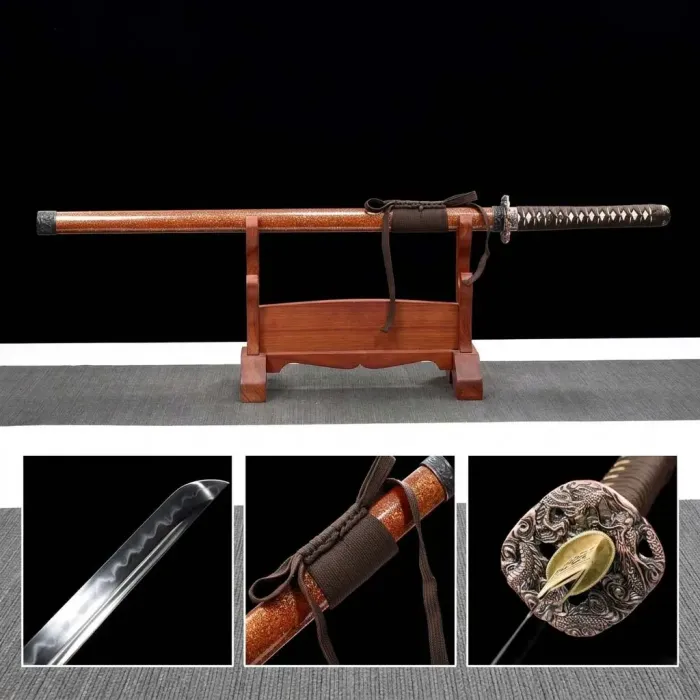
The age-old oriental sword exists as a impressive piece of craftsmanship, but how about you want to show your individual mode? Altering your instrument is a enriching journey, allowing you to design a truly exceptional piece. From the grip wrapping and collar to the plate design and marking, each detail offers a chance for tailored look. This analysis delves into the space of katana modifications, providing details for both initiates and experienced enthusiasts pursuing to inscribe their mark on the time-honored art of the samurai.
Primary Authentic Artistry
For starters motivated to embark on the fulfilling journey of eastern weapon training , 1060 steel katanas present an ideal entry point. This defined grade of essential steel meets a ideal mix between low price and functionality . While inferior to hard as leading steels, 1060 accommodates a reasonable level of honing , making it ideal for starters to enhance the groundwork of blade care and enjoy the charm of original Japanese weaponry. It’s a superb choice for fostering experience without the fiscal burden of more elite steels.
T Gear Steel Weapons : Combining Excellence and Reasonableness
Satisfying specialists seeking an authentic cutting instrument experience without crossing the financial plan, T10 composition katanas represent a inviting option. These cutlery offer a distinct improvement in strength compared to substandard alternatives, exhibiting fair edge retention and enough flexibility for fundamental slicing techniques. While not rivaling the superior characteristics of fine steels like T100 or folded element , T10 provides a commendable blend of efficiency and cost-effectiveness , making them a widespread choice for newcomers and those on a modest resources .
Exceeding the Sword : Personalizing Your Katana's Enhancements and Shaft
Even though the honed metallic edge is undeniably the key point of a katana, truly amplifying its beauty lies in the detailed customization of its accessories and grip . This operation allows admirers to showcase their inimitable manner . Think about the sweeping possibilities: menuki - decorative accents that contribute visual attraction ; the hamon wrappings – often elaborately molded ; the tsuka basis itself, wrapped in authentic ito binding ; and the fusa end piece , which can be constructed from various components like valuables or tusk .
- Select designs that connect with you.
- Assess with varying resources .
- Emphasize strength for a enduring influence .
The Attraction of the Katana: Legacy, Artistry, and Steelwork
An historical weapon possesses a exclusive allure, steeped in phases of the nation's history and folklore . More than merely a apparatus of combat , it's a mark of the fighter class ethos – a fusion of mastery and governance . Its unfolding spanned numerous generations, with early cutting instruments evolving into the sleek-lined curvature and deadly edge we know today. The manufacture involved is truly spectacular, requiring decades of study to excel at . The process involves a sophisticated folding of tamahagane , creating layers that strengthen the weapon’s flexibility and hacking ability. Different schools of forging emerged , each with their specific secrets and procedures for achieving the exceptional steadiness and sharpness - a truly arduous pursuit.
- Primitive Katana types
- The part of the cutting armament in soldier culture
- Established processing methods
Selecting the Best Steel for Your Japanese Sword Project: 1060 vs. T10
Deciding on the suitable steel is vitally important for any cutting weapon project, and the selection between 1060 and T10 can be challenging. 1060 is a T10 steel katana widely used American alloy, offering a reasonable balance of durability and robustness, allowing it fairly easy to temper. However, T10, a Japanese steel, generally boasts exceptional wear permanence and can may achieve a superior definitive hardness, although it can be significantly hard to manage and requires careful heat processing. Consider your experience level and aimed features: for a novice, 1060 may be a better entry, while the experienced smith might use the expanded characteristics of T10.
- Effortlessness of Handling
- Wear
- Terminal Firmness
Accessing Excellence: Progressive Katana Alteration Approaches
Developing mastery in sword adjustment extends far beyond basic sharpening. Serious connoisseurs are now probing advanced techniques to truly reveal a blade's hidden potential. This demands intricate work with the temper design, utilizing specialized substances for differential processing and carefully picking the profile of the shield to optimize balance and effectiveness. Beyond purely functional enhancements, artisans are increasingly focused on attaining unparalleled aesthetic appeal, through complex cutting and layered coatings that truly transform a katana into a artistic composition.
Forging a 1060 Katana: From Raw Metal to Masterpiece
The journey opens with ordinary 1060 compound , a tough material far separated the refined katana it will turn into . Skilled bladesmiths practice a complex process of integrating and constructing the unrefined steel, repeatedly tempering it and pounding it to rid impurities and create a steady grain structure. This time-consuming process, often extending for intervals , builds the necessary power and adaptability characteristic of a genuine Japanese saber . Later heat processes , including meticulous hardening and setting , are vital to achieve the sought-after proportion of sharpness, durability and grace .- Combining: Diminishes impurities and creates grain structure.
- Crafting: Builds the steel into the initial blade form.
- Hardening: Determines the final hardness and flexibility.
The Durable Charm of the Katana: Intensive Inspection of Steel and Adaptation
A historic katana holds present a intense symbol denoting Japanese heritage , its fascination far exceeding mere armaments . Forged from rare steel and habitually featuring intricate trims, the process of creation itself is a sacred art. Beyond the basic craftsmanship, the ability to modify a katana - from the temper curve to the grip wrapping and clasp - opens for a sincerely individual demonstration for both worshippers and participants alike. This confluence of classical steelwork and boundless personalization creates the katana's continued popularity across the globe .
