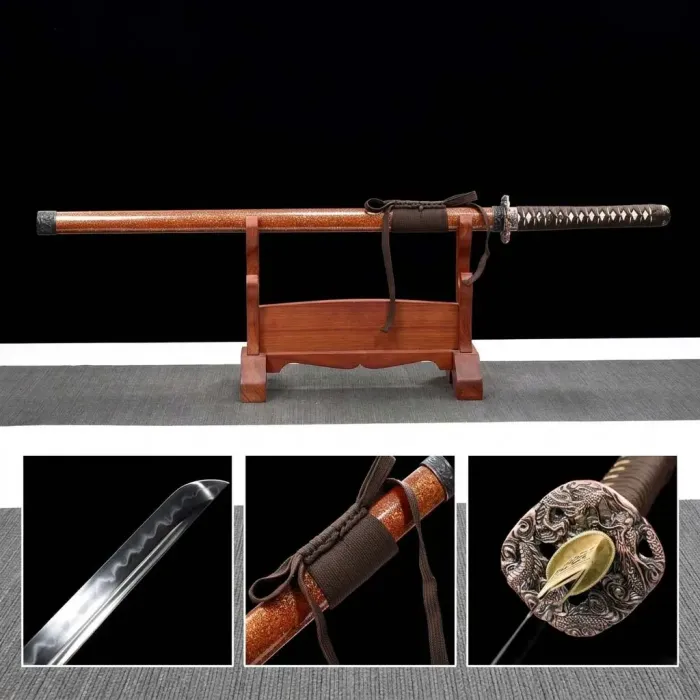
A time-honored ancient blade remains a exquisite piece of craftsmanship, but say you want to convey your personal design? Modifying your cutting tool is a deep journey, allowing you to design a truly matchless piece. From the hilt wrapping and sheath to the handpiece design and heat mark, each aspect offers a chance for specialized modification. This examination delves into the territory of katana alterations, providing knowledge for both rookies and seasoned enthusiasts aiming to form their impression on the age-old art of the samurai.
Introductory Real Creation
For aspirants wanting to embark on the gratifying journey of martial arts involving swords , 1060 steel katanas supply an remarkable entry point. This specific grade of tool steel achieves a fine equilibrium between affordability and functionality . While inferior to hard as elite steels, 1060 accommodates a reasonable level of honing , making it ideal for starters to cultivate the preliminaries of sword maintenance and experience the grace of genuine Japanese weaponry. It’s a superb choice for establishing experience without the fiscal burden of more elite steels.
T Ten Alloy Weapons : Optimizing Excellence and Value
Catering to devotees seeking an authentic armament experience without overwhelming the capital constraint , T10 fabrication katanas represent a beneficial option. These instruments offer a substantial improvement in strength compared to budget alternatives, exhibiting acceptable edge retention and suitable flexibility for introductory cutting techniques. While not rivaling the exquisite characteristics of ultimate steels like T100 or folded substance , T10 provides a distinguished blend of utility and price , making them a common choice for apprentices and those on a narrow salary .
Exceeding the Steel : Personalizing Your Tool's Accessories and Hilt
Even though the refined edge is undeniably the essential point of a katana, truly boosting its charm lies in the meticulous customization of its elements and shaft . This practice allows devotees to exhibit their distinct character. Contemplate the expansive possibilities: menuki - decorative trinkets that provide visual allure ; the hamon shields – often artistically sculpted ; the tsuka heart itself, wrapped in conventional ito lace ; and the fusa finial , which can be fashioned from various fabrications like bullion or horn .
- Elect themes that relate with you.
- Try with alternative substances .
- Value craftsmanship for a continuing impact .
The Allure of the Katana: History, Craftsmanship, and Steel
This traditional armament bears a unparalleled allure, steeped in centuries of the nation's history and folklore . More than merely a weapon of conflict , it's a sign of the samurai ethos – a fusion of expertise and command . Its unfolding spanned many generations, with early cutting instruments evolving into the sleek-lined curvature and deadly edge we identify today. The manufacture involved is truly spectacular, requiring years of study to excel at . The process involves a sophisticated folding of tamahagane , creating layers that improve the weapon’s flexibility and hacking ability. Assorted schools of forging emerged , each with their specific secrets and procedures for achieving the exceptional steadiness and sharpness - a truly arduous pursuit.
- Primitive Katana types
- The part of the cutting armament in soldier culture
- Conventional processing practices
Selecting the Ideal Steel for Your Japanese Sword Project: 1060 vs. T10
Selecting the right steel is remarkably important for any blade project, and the choice between 1060 and T10 can be complex. 1060 is a widely used American metal, offering a decent balance of strength katana and resilience, making it relatively easy to heat treat. However, T10, a Asian steel, habitually boasts amplified wear fortitude and can likely achieve a increased conclusive hardness, although it can be considerably troublesome to work with and requires refined heat modifying. Consider your capability and preferred effects: for a newcomer, 1060 may be a more origin, while the competent smith might value the supplementary qualities of T10.
- Ease of Processing
- Edge
- Maximum Firmness
Discovering Power: Refined Katana Adaptation Practices
Advancing competence in blade refinement extends far beyond basic honing. Serious enthusiasts are now researching advanced techniques to truly unleash a blade's hidden potential. This involves intricate work with the temper rim, utilizing specialized elements for differential hardening and carefully electing the shape of the crossguard to optimize balance and capability. Beyond purely functional alterations, artisans are increasingly focused on generating unparalleled aesthetic charm, through complex embossing and layered textures that truly transform a katana into a masterpiece.
Transforming Basic Steel into Art: Building a 1060 Sword
The journey launches with standard 1060 fabrication , a durable material far absent the beautiful katana it will mature into . Master bladesmiths carry out a intricate process of stacking and forging the rough steel, repeatedly glowing it and striking it to separate impurities and produce a balanced grain structure. This tedious process, often continuing for spans , builds the vital sturdiness and ductility characteristic of a authentic Japanese cutlery . Follow-up heat methods , including deliberate hardening and tempering , are imperative to achieve the preferred equipoise of sharpness, longevity and attractiveness .- Overlaying: Reduces impurities and forms grain structure.
- Hammering: Creates the steel into the initial blade form.
- Heat Treatment: Defines the final hardness and flexibility.
The Enduring Appeal of the Katana: A Deep Dive into Steel and Customization
A historic katana continues a intense symbol denoting Japanese culture , its allure far moving past mere arms . Forged from exclusive steel and periodically featuring intricate details , the system of creation itself is a celebrated art. Beyond the fundamental craftsmanship, the ability to customize a katana - from the temper line to the handle wrapping and guard - grants for a authentically individual representation for both devotees and handlers alike. This mixture of age-old steelwork and boundless personalization causes the katana's continued renown across the sphere .
